 Health & Wellness
She Lost 34 Pounds on Ozempic. Then She Lost the Energy to Get Off the Couch.
Thousands of women on GLP-1 medications are reporting the same pattern: the weight disappears, but so does their energy. New research into mitochondrial peptides may explain why — and what to do about it.

Jennifer is 51 years old. Last January her doctor prescribed semaglutide. By May she had dropped four dress sizes. Her bloodwork improved across the board. Her friends told her she looked ten years younger.
But Jennifer didn't feel younger. She felt old.
"By 2 p.m. every day I was done," she says. "Not tired — done. Like someone had pulled the plug. I'd sit in my car after picking up my daughter and just stare at the steering wheel. I didn't have the energy to walk inside."
Her doctor told her the fatigue would pass. It didn't. He suggested eating more protein. She was already eating 120 grams a day. He told her to check her thyroid. It was normal. He told her to give it time.
Six months later, she was still exhausted.
Jennifer is not unusual. She is typical.
In GLP-1 patient communities — on Reddit, in Facebook groups, on TikTok — the same complaint surfaces thousands of times a week: the weight is coming off, but I have no energy.
This isn't the ordinary tiredness of eating less. Women describe it differently. They use words like "bone-deep." They say it feels cellular. They say it's unlike any fatigue they've experienced before — including pregnancy, menopause, and postpartum.
The standard medical advice — more protein, more water, better sleep — does not resolve it for a significant number of patients. And the reason, according to a growing body of research, is that the problem isn't nutritional. It's mitochondrial.
What happens inside your cells when you lose weight fast
Every cell in your body has tiny power plants called mitochondria. Their only job is to turn food into energy. You have trillions of them. They make the fuel your body needs for everything — thinking, walking, breathing, even healing.
When you lose weight fast — for any reason — those power plants get thrown off. The signals they depend on change. The nutrients they need change. Your hormones change. Your mitochondria have to adjust to a completely new environment inside your body.
For many people, especially women over 45, that adaptation stalls.
Why women over 45 are hit hardest: Mitochondrial function naturally declines with age. Research published in Cell Metabolism has documented a measurable reduction in mitochondrial efficiency beginning in the mid-40s. GLP-1-driven weight loss adds a second layer of metabolic stress on top of this age-related decline — creating a compounding energy deficit that younger patients are less likely to experience.
The result is a body that weighs less but produces less energy at the cellular level. The scale says you're healthier. Your cells disagree.
This isn't a simple "side effect" like nausea. It's a deeper problem with how your cells make energy — and most doctors aren't looking for it.
A peptide your body already makes — but probably not enough of
In 2015, researchers at the University of Southern California published a discovery that changed mitochondrial science. They identified a small peptide — just 16 amino acids long — encoded directly in mitochondrial DNA.
They named it MOTS-c.
MOTS-c (Mitochondrial Open Reading Frame of the 12S rRNA Type-c) is not a synthetic compound invented in a lab. It is a signaling peptide your own mitochondria produce naturally. Its job is to regulate how your cells produce and use energy. And as of October 2026, licensed compounding pharmacies can legally prepare and dispense it under a physician's prescription.
What the researchers found was striking:
- MOTS-c directly activates AMPK, the enzyme your cells use to sense and respond to energy demands — the same pathway that exercise activates
- Circulating levels of MOTS-c decline measurably with age, with the steepest drop occurring after 45
- In lab studies, MOTS-c improved energy output, exercise ability, and how well the body handles its metabolism
- MOTS-c appears to help mitochondria adapt to metabolic stress — exactly the condition created by rapid GLP-1-driven weight loss
Published research on MOTS-c has appeared in Cell Metabolism, The Journal of the American Medical Association network, and other peer-reviewed journals. It is one of the most studied mitochondrial-derived peptides in the scientific literature.
Put simply: MOTS-c helps mitochondria do their job. And your mitochondria's job is to give you energy.
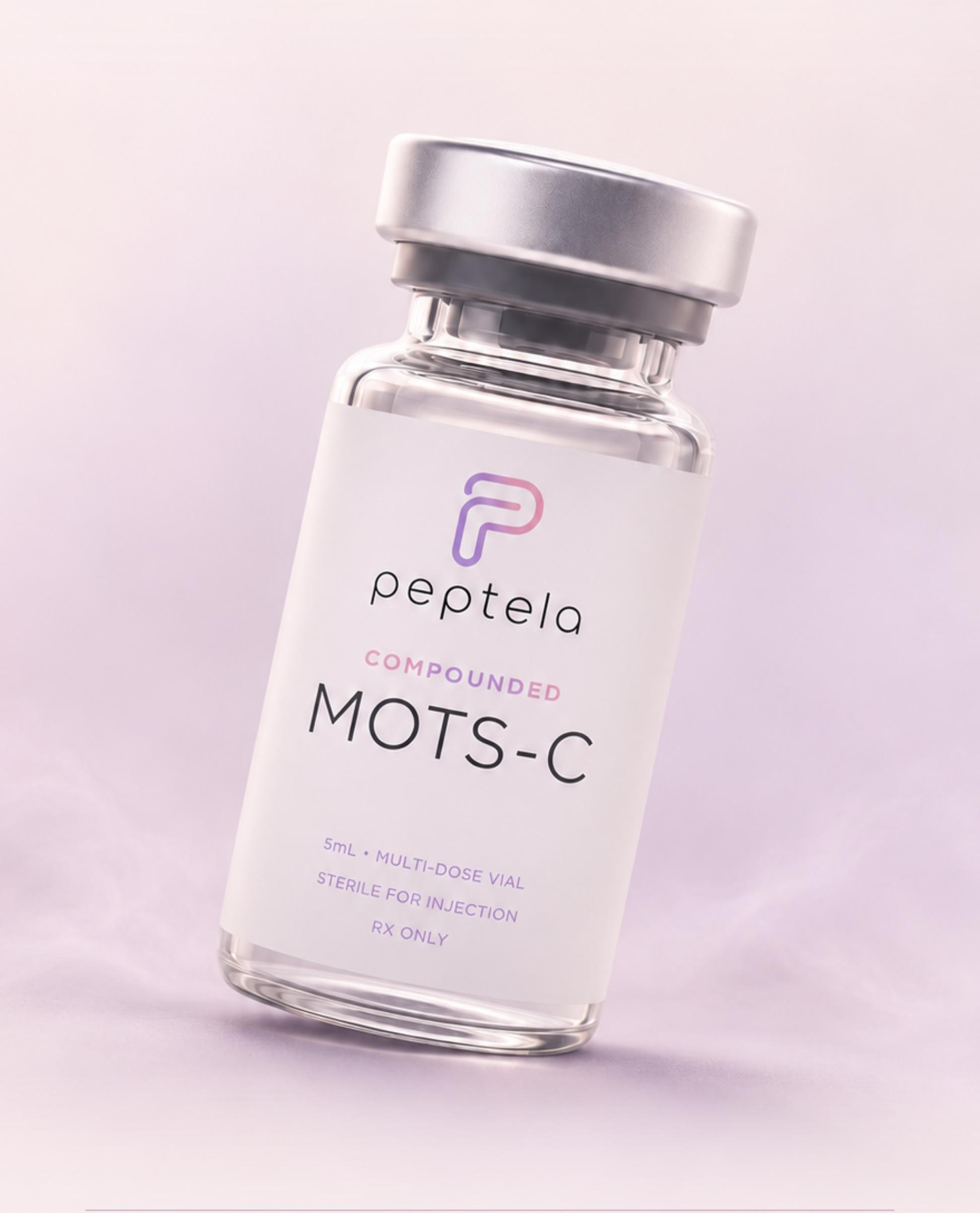
Peptela Compounded MOTS-c · 2 mg/mL · 5 mL multi-dose vial · Rx only
This is not caffeine. This is not a stimulant. This works at the source.
Most solutions for GLP-1 fatigue try to override the problem. Caffeine forces alertness without fixing the underlying energy deficit. B-vitamin complexes address deficiency, not dysfunction. Pre-workout supplements mask the symptom for an hour.
MOTS-c works differently. It operates at the level where the energy problem actually lives — inside the mitochondria themselves. It doesn't stimulate. It doesn't override. It supports the cellular machinery that produces energy in the first place.
This distinction matters. A stimulant borrows energy from later. A mitochondrial peptide helps your cells make more of it now.
What women on GLP-1s are saying
"I've been on Mounjaro since March. Added MOTS-c in August. The afternoon crash that had me canceling plans three days a week is gone. I actually went to a 6 p.m. yoga class last Tuesday. That hasn't happened in a year." — Laura M., 53, Scottsdale, AZ
"My doctor had never heard of MOTS-c. I brought in two published studies and asked if there was any reason I shouldn't try it. She said no. Six weeks later, even she noticed a difference. I'm not dragging anymore." — Karen W., 47, Nashville, TN

"I was about to quit Wegovy. The fatigue was worse than the weight. MOTS-c didn't change everything overnight, but after about three weeks I realized I wasn't napping at lunch anymore. That was the first sign. Now I have my afternoons back."
Diane R.
55 · Portland, OR · Wegovy patient
(Individual experiences vary. MOTS-c is available by prescription through licensed compounding pharmacies. It is not an FDA-approved drug.)
Why most doctors haven't mentioned this to you
Doctors are trained to prescribe medications and track your progress. GLP-1 drugs are very good at what they do. But the energy problems caused by fast weight loss — especially what happens inside your cells — don't come up in a 15-minute checkup.
Mitochondrial peptide research is relatively new. MOTS-c was identified barely a decade ago. It is not yet part of the standard curriculum in medical schools. Most endocrinologists are aware of it as a research compound. Few are recommending it to patients, because few are being asked about it.
That changed in October 2026, when HHS authorized licensed compounding pharmacies to prepare MOTS-c under a physician's prescription. The access is here. But if you're waiting for your doctor to bring it up, you may still be waiting a long time.
Specific facts, not vague promises
MOTS-c is a 16-amino-acid peptide encoded by the 12S rRNA gene in human mitochondrial DNA.
It was first characterized in 2015 by Dr. Changhan David Lee and colleagues at the USC Leonard Davis School of Gerontology.
MOTS-c activates AMPK, the same energy-sensing enzyme activated by exercise — often called the body's "metabolic master switch."
Circulating MOTS-c levels decline with age, with research showing significantly lower levels in adults over 45 compared to younger cohorts.
As of October 2026, MOTS-c can be legally compounded by licensed pharmacies under a physician's prescription, following the HHS enforcement discretion policy covering six peptides including MOTS-c.
Peptela connects patients with prescribing physicians and licensed compounding pharmacies dispensing pharmaceutical-grade MOTS-c, specifically for women managing the metabolic demands of GLP-1 therapy.
Two types of GLP-1 patients
There are women who lose the weight on their GLP-1, accept the fatigue as the cost, and power through. Some of them adapt. Some of them don't. Some of them quit their medication entirely because the exhaustion becomes unbearable.
And there are women who ask why. Who look into what is happening at the cellular level. Who find the research. Who try a targeted intervention instead of another cup of coffee.
Jennifer was in the first group for eight months. Now she's in the second.
"I wish someone had told me about this in month one," she says. "I spent half a year thinking something was wrong with me. Nothing was wrong with me. My cells just needed something I wasn't giving them."
Your GLP-1 took care of the weight. MOTS-c is for the energy your cells lost along the way.
Peptela connects women on GLP-1s with prescribing physicians and licensed compounding pharmacies dispensing pharmaceutical-grade MOTS-c.
Get Started with MOTS-c
MOTS-c is not an FDA-approved drug. It is available through licensed compounding pharmacies under the HHS enforcement discretion policy of October 28, 2026, with a valid physician's prescription. Compounded drugs are not FDA-approved and have not been evaluated by the FDA for safety, effectiveness, or quality. These statements have not been evaluated by the Food and Drug Administration. Consult your physician before starting any new treatment, especially if you are currently taking prescription medication. Individual results vary. Testimonials reflect individual experiences and are not guaranteed outcomes.